The challenge
For most communities in Papua New Guinea, village courts and land mediation are the ‘first response’ for resolving disputes. Access to these services is constrained by where people live, how they travel and communicate, what they can afford, cultural expectations and information availability. With communities still feeling the impacts of COVID‑19 and the 2022 election‑related violence, we were tasked with evaluating the accessibility and performance of these services in some of most conflict-prone and geographically challenging areas in the Papua New Guinea Highlands region. We set out to navigate this complexity with our trusted in‑country partner, Asples Pacific Research, and generate clear, evidence‑based recommendations to strengthen service delivery and shape the future justice program.
Our approach
To really understand access to justice in Papua New Guinea, we went beyond just statistics and heard directly from people whose daily lives are shaped by village courts and land mediations. Building on our earlier work with the Justice Services and Stability for Development Program (JSS4D) and Asples Pacific Research, we combined conversations in communities with a careful look at program records and previous evaluations.
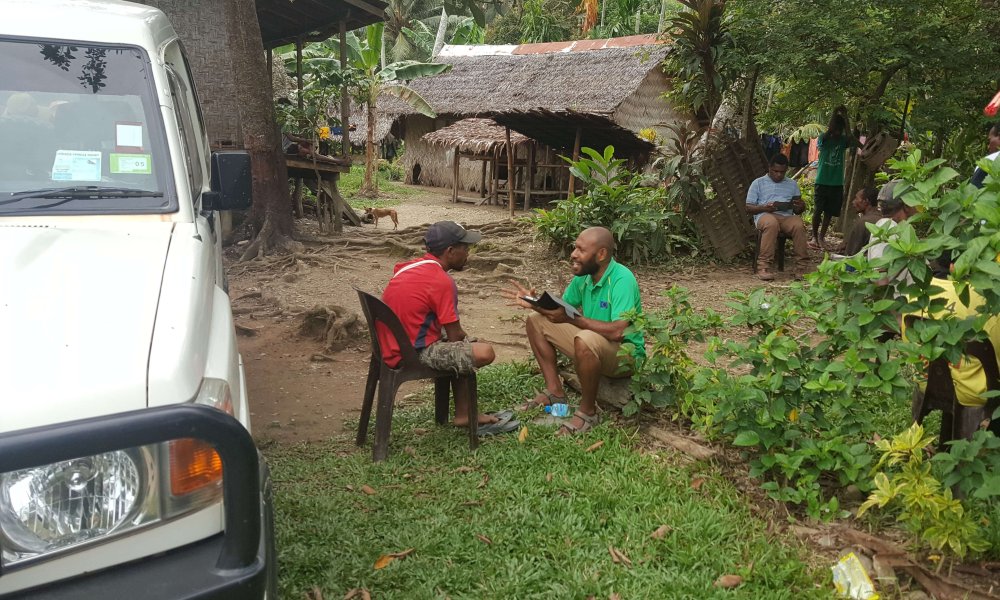
Our team sat down with elders, women, young people, court officials and mediators, listening to stories about the challenges of getting to hearings, paying for transport, or navigating cultural expectations. These discussions were supported by surveys that allowed us to capture broader trends across provinces, with tools designed to connect back to our 2020 evaluation so that we could see what had changed over time.
We worked closely with JSS4D to shape the research, starting with scoping interviews that sharpened our questions and ending with a validation workshop that brought key agencies into the room. This process not only tested our findings but also created space for dialogue about the future of village courts and land mediation services.
Outcome
Our evaluation painted a mixed but instructive picture of how village courts and land mediations are working across the country. We saw clear progress, especially where officials had received training, where mobile phones were improving communication, and where court manuals gave structure and guidance. In some places, people spoke about justice feeling ‘closer at hand’.
But the story was uneven. Access looked very different depending on whether you lived in a town, a rural community, or a remote part of the Highlands. Transport costs and court fees were the biggest hurdles for many people, shaping both the demand for and the supply of services.
Importantly, we were able to show how the JSS4D program had made a real difference since 2018, strengthening the skills of court officials, improving accountability, building infrastructure, and raising awareness in communities about their rights and the services available.
The evaluation also set out 10 practical considerations for the future. These touched on everything from the role of technology and the way officials are paid, to how urban and rural experiences differ, the need for better data, and the value of creating more opportunities for learning among officials. Together, they offer a roadmap for making village courts and land mediations more accessible, inclusive, and effective in the years ahead.
More Sustineo projects

Monitoring and Evaluation of Socio-Economic Impacts of Pearl-based Livelihood Development