The challenge
Workers and their families need to navigate a complex journey: preparing for departure, managing family separation and finances, understanding and exercising workplace rights, and eventually returning home and reintegrating into family and community life.
Labour mobility is an increasingly important livelihood pathway for I-Kiribati workers and their families, particularly through Australia’s Pacific Australia Labour Mobility (PALM) scheme and New Zealand’s Recognised Seasonal Employer (RSE) scheme. But the benefits and challenges of migration extend well beyond the period a worker spends overseas.
The International Labour Organization (ILO), with funding from the Millennium Challenge Corporation, engaged Sustineo to undertake a baseline Knowledge, Attitudes and Practices (KAP) study for its Mwakuri Aika a Raraoi Ibukimi 2 (MARI 2 – Decent Work for All) activity. The challenge was not simply to establish baseline figures, but to generate evidence that could help MARI 2 better respond to workers’ and families’ experiences across the full migration cycle.
Our approach
We designed a mixed-methods study that combined research rigour with local knowledge and practical experience.
The study included a desk review and scoping consultations, alongside separate KAP surveys for returned migrant workers and family members. The instruments explored knowledge, confidence and practices before departure, during overseas employment, and following return and reintegration. They also incorporated gender equality, disability and social inclusion considerations, including the Washington Group Short Set of Questions on disability.
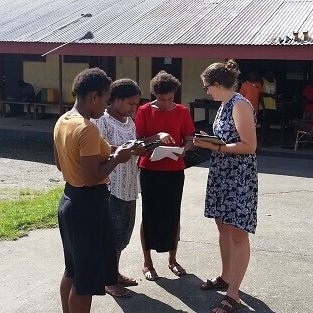
A key strength of the approach was working in partnership with a Kiribati-based field team. Our Country Leader, two Field Team Leaders and eight experienced enumerators from the Kiribati National Statistics Office undertook the fieldwork in South Tarawa, with Sustineo providing remote training, technical support and survey management. Working with the Ministry of Employment and Human Resources, and supplementing existing participant databases through online outreach, the team reached 191 returned migrant workers and 182 family members.
We also conducted seven key informant interviews with organisations spanning government, training, the private sector, trade unions, disability, women’s organisations, health and community services.
Survey data were cleaned and analysed in R, then triangulated with the qualitative interviews, desk review and stakeholder validation. This allowed us to look beyond the numbers and understand some of the experiences and systems shaping them.
Outcome
The study established a robust baseline for MARI 2 against five outcome indicators, covering areas including workers’ preparedness to exercise their rights overseas, families’ capacity to manage the impacts of migration, preparedness for return, and worker and family reintegration planning.
More importantly, it translated those findings into practical priorities for the program.
The evidence highlighted opportunities to strengthen engagement with community organisations and service providers; support family-based financial literacy and planning; improve confidential and collective mechanisms for raising workplace concerns; provide stronger return and reintegration support; and make labour mobility pathways more inclusive for people with disability.
We also developed reusable survey instruments and recommendations to improve worker databases, longitudinal monitoring and future KAP surveys. This means the baseline is not a one-off snapshot: it provides a foundation to track change over time and assess whether MARI 2 is making a difference for workers and their families.