Loss & Damage has had a long history of advocacy – what next?
Climate ‘Loss and Damage’ (or L&D) refers to the worst impacts of climate change – the things that are very hard to avoid or adapt to, or that are truly unavoidable. Since 1991, small island nations in particular have been advocating for recognition of L&D and its inherent admission that the world cannot simply adapt to any and all consequences of failing to mitigate fast and deep enough. Globally, we are irrevocably on a pathway in which permanent harm is being created.
It took another 22 years of advocacy and eventual UN negotiation to establish the Warsaw International Mechanism on Loss and Damage (2013) – the first official UN body for L&D, designed to strengthen knowledge and coordination and enhance support. It took a further 10 years before there was agreement in 2023 to operationalise the Fund for Responding to Loss and Damage (FRLD) to provide specific financial assistance to help countries take actions that ‘respond to’ or ‘address’ loss & damage. And this year, for the first time, countries have the opportunity to apply to the FRLD for assistance. After 35 long years of advocacy and negotiations, the focus can finally shift to taking substantial, tangible action.
It’s not just concepts and jargon – it’s real and confronting
But what actions should be taken? What does ‘responding to’ or ‘addressing’ L&D actually involve? Substantial work has been done to lay the path toward action but much of it involves a lot of concepts and jargon. Economic versus non-economic. Arising from slow onset versus rapid shock events. Understanding the ‘limits to adaptation’. This is understandable as people try to define what L&D IS and ISN’T, especially to ensure eligibility of actions for dedicated sources of L&D funding.
Unfortunately, the dominance of concepts and jargon in L&D scholarship and conversations has a tendency to make L&D itself seem conceptual rather than real. Yet to people living their lives in vulnerable situations, it is VERY real. I had a clear reminder of this when I arrived for my latest visit to Vanuatu as part of our work to support the government develop a long-term L&D action plan and apply for financial support to the FRLD (funded through the generous support of the Santiago Network).
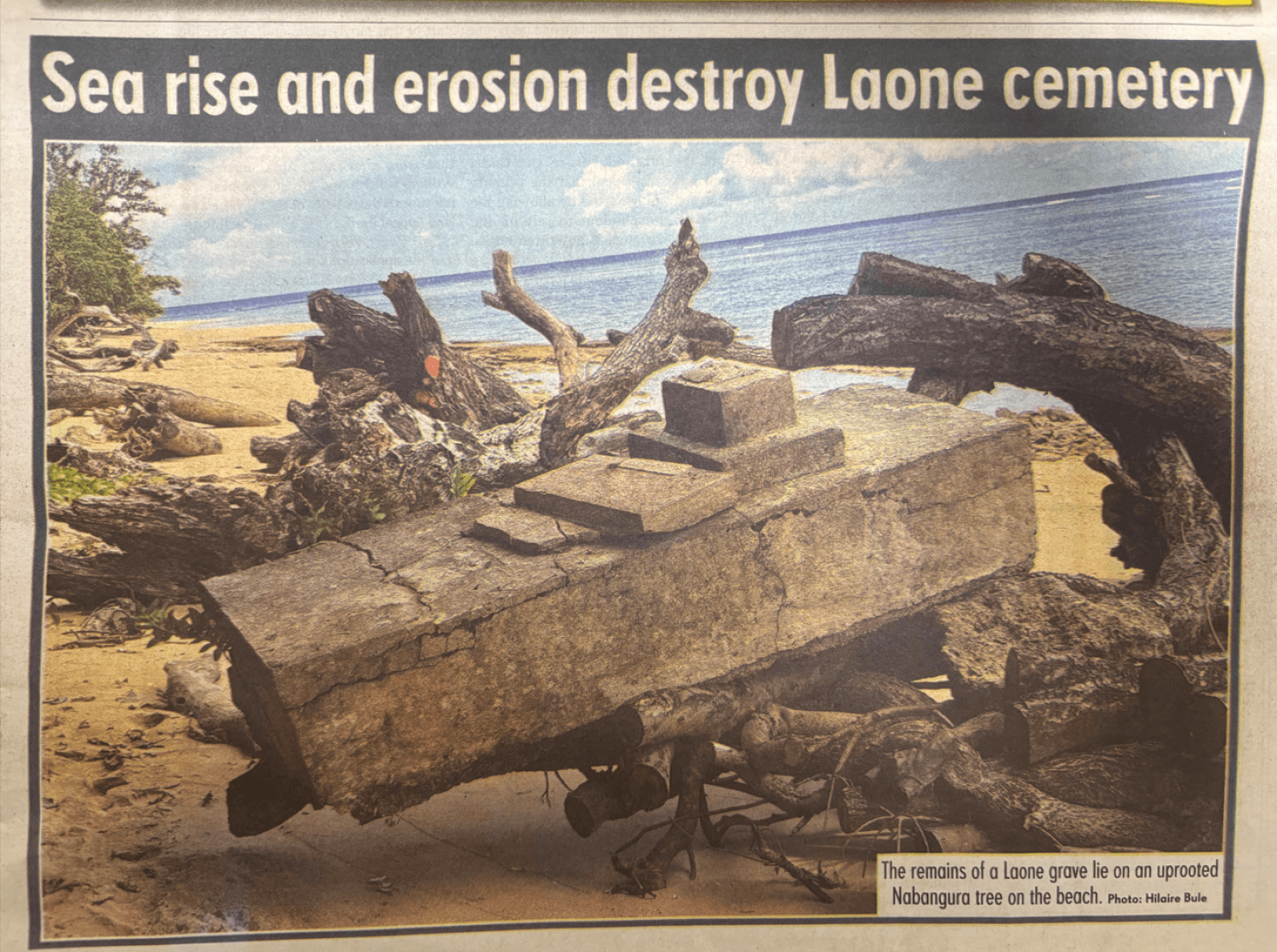
On the very day I arrived, the front page of the Vanuatu Daily Post featured a photo and a story about sea level rise and coastal erosion destroying a cemetery in North Pentecost. People had planted trees and built walls to reduce wave impact but despite their efforts, the remains of many of their ancestors had already been washed out to sea. Just imagine if this was your mother or grandfather that had been taken away from their resting place like this! It is just one example that shows how specific and tangible L&D can be – and how it can cut to the very heart of people’s connection with family and place in ways that may be deeply damaging psychologically in addition to the more obvious physical damages.
Response actions need to be real too!
As we move forward from 35 years of advocacy into a period of action, we can’t afford to get lost in jargon. We need responses to L&D to be just as real and tangible as the impacts themselves. We need to think practically and clearly, and work with the people directly affected, to anticipate these losses and damages and take substantially different actions to avoid the worst outcomes.
Responding to L&D is not about incremental changes to the way we currently do things. It’s about starting the journey of substantially changing where people live, how they get their food and income, how future-proofed our infrastructure is, how we provide for the growing demand for mental health and social support services – all specifically targeted to the types of losses people have been and will increasingly be experiencing.
It’s about recognising that graves are likely to be lost and finding ways to keep ancestors on country and remembered in people’s stories and hearts as much as possible, perhaps through alternative grave sites and sea-side memorials. It’s about anticipating where nearshore fisheries are likely to collapse and providing the opportunities for people to shift to new sources of food and income with support, confidence and dignity. It may even be an inspiring opportunity to build on traditional values and practices of reciprocity, creating modernised ways to reconnect across cultural groups and support each other when support is needed.
Helping Pacific countries respond through the Nabanga L&D Consortium
Here at Sustineo, we see this shift from advocacy to action as a pivotal moment in L&D and one that requires new and different skills. It means more skills in community facilitation, stimulating local innovation, building systemic support systems, and new types of capacity development – in addition to the data systems, advocacy/negotiation and policy development skills that have dominated to date. This is why we have joined with others in forming the Nabanga Loss and Damage Consortium. Together with the Institute for Study and Development Worldwide, Pacific Advisory and the Santo Sunset Environment Network, we are serving the Pacific region, providing the new types of support needed to develop practical, actionable and even hopeful and inspiring responses to Loss and Damage.
Stay tuned for future news about our L&D work and please don’t hesitate to get in touch if you are also working at the forefront of practical L&D action on the ground. Sustineo likes to share ideas and inspiration. As so beautifully said by the Japanese writer Ryūnosuke Satoro, ‘Individually, we are one drop. Together, we are an ocean.’
About the author: Dr Veronica Doerr is Sustineo's CEO. As a strategic leader and climate resilience expert with a career dedicated to connecting research, policy, and practice, Veronica helps individuals and organisations navigate the ‘messy middle’ of global challenges – aligning strategies, funding, and action for greater impact.